
The Last Job I’ll Ever Have
In the last job I’ll ever have, I was Head of Strategy of an 800-person PR agency in New York. I was told that new senior hires never fitted in. I was told that most people in the agency didn’t want strategists. I was told that the company wanted to do “earned media ideas,” which meant very different things to each of us because, to me, getting words from a press release into the news was low aura stuff. And, despite red flags that I desperately ignored, I took the job so that, later, I could be told, “You’re not a culture fit.”
PR is an individualistic, full-contact sport. PR people live and die by their network, their ability to influence their network, and their personal reputations that lead to more network to influence.
In New York City, where every second person says they’re a Type A personality and they’re either desperately trying to keep a grip on living in one of the most expensive cities in the world or they’re a nepo baby and they’re given an assistant during their summer internship (true story), the Corporate America vibes are frothy and feral.
I was a sucker in this environment. I tried to play soccer when I needed to play tennis. Singles tennis. With a sword.
And then it happened:
- “Hi there, my boss told me to come and ask you for an insight for our deck. We need to send it in two hours.”
- “Oh, would you like fries with that?”
Constantly, strategists were treated like internal service providers:
- “Give me stuff that makes me look smart in front of my clients but please don’t come out of the shadows as I have a reputation to handle.”
But here’s the thing: strategy is not a back-office function.
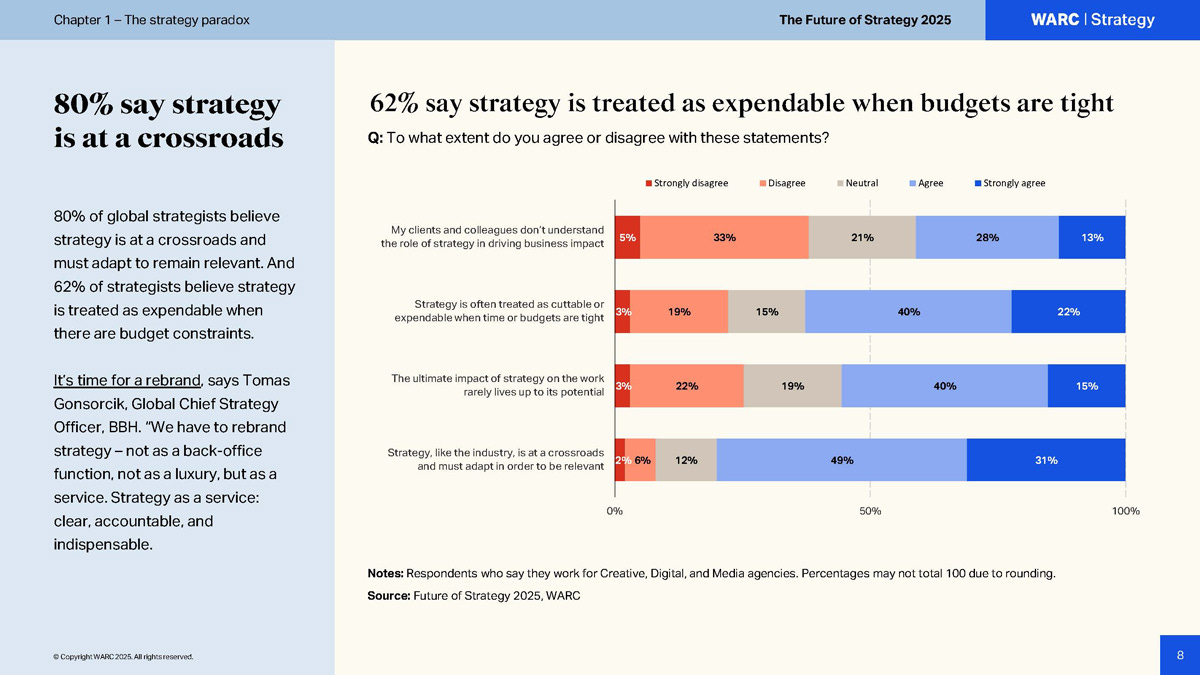
Lena Roland, Content Director at WARC, shared the above piece of research from WARC’s annual “The Future of Strategy Report 2025” .
On the left, you’ll see Tomas Gonsorcik, Global CSO, say this:
“We have to rebrand strategy - not as a back-office function, not as a luxury, but as a service. Strategy as a service: clear, accountable, and indispensable.”
It took me moving to New York to understand how muscular advertising agencies and strategy are (or, were) in countries like Australia, New Zealand, and the UK.
In high-performing agencies, there is an aggressive focus on the work. Fighting for it. Everyone. Otherwise - get out of the way.
Agencies that focus on organizational charts, process, and job titles tend to be low-performing agencies because they have no creative heart.
But, like many of you, I thought my problem was a Me Problem and not an Us Problem.
I thought I just didn’t have the political skills or will to help strategy move from the back-office to the front-office in this particular agency. And the gaslighting made me realize how much I love strategy - doing it and teaching it - but how I’m allergic to Corporate America. So I built what I do now.
Front-Office Strategy Is Not That Hard
There are a few things that need to be in place for strategy to be front-office:
1. A sense of team over individual
Strategists can struggle in PR firms because PR firms are individualistic, plus they’re riddled with nepotism and dotted lines and matrix org charts. What’s more, creative departments often hold people who’ve never worked with strategists before. Yes, this has changed a little but I do speak with hundreds of people around the world every year so I’m not going to congratulate incremental change.
Strategists are rarely the first point of contact in an agency so they need the first point of contact to pull them in early and keep them there often. This will only happen if the first point of contact wants to play a team sport and has the leadership skills to do so.
2. Time to build real relationships with clients
In most agencies, the account management team will be in the pocket of their clients. But they will allow the strategist time to build relationships without feeling insecure about it. The strategist will also seek a direct line with key clients so they can have informal conversations about the work. If each interaction is formal and performative, the strategist might struggle to encourage the kind of work their team is capable of.
3. A charismatic strategy team and leader
Vibes matter. We’ve all worked with people who could make clients and colleagues swoon. A stiff, boring, and corporate strategy team will struggle to be front-office. If they constantly bore people, their own colleagues will shift them to the back-office anyway.
4. A reputation that precedes the strategy team
Around 2008, I started writing about strategy. At first, I didn’t want to be that guy but then I saw the offices of my clients empty out during the financial crisis and I got tired of competing in meetings. So I decided to write so that, in many rooms I’d enter, people might have a sense of how I thought before I entered the room.
I was working at Leo Burnett at the time. My boss was Todd Sampson, a strategist with a big reputation and, since then, someone who’s appeared on many TV shows. And the people I worked with all had amazing pedigrees and brands. We were competitive and we cared about doing good work. Clients wanted us in the room.
We didn’t have to constantly explain ourselves as happens so often in the USA in companies new to all of this and who don’t really want to change.
We just did the work and tried to help some of the best creative teams in the country do their work.
Just like with brands, strategy teams need reputations because reputations pull people into situations for which they don’t have to go sniffing around the building.
5. An unapologetic business model
Procurement has made a mess of our industry. The way agencies have had to open their books to reveal salaries and margins to clients is an embarrassment. Sure, there are a few people in procurement and a few forceful marketers who’ll fight to bring in their agency, but, mostly, Corporate America forces a blandness onto everything it touches - including the agency business model.
When strategy is strong and front-office, it appears on scopes by default. The Head of Strategy doesn’t have to chase projects through the corridors to beg for a strategist to be put on projects.
The Ultimate Front-Office Green Flag
Years ago, I interviewed Ilana Bryant. I believe Ilana was the first American planner to work in London. This is quite a feat considering how Brits perceive Americans.
In the interview, she said that if a strategist’s or account planner’s name was on the building then it meant strategy or account planning was a legitimate activity in the agency.
These days, agencies don’t have such cute names as the partners’ initials but, as I’ve wondered why I made so many poor career decisions in New York and why I was eventually serving fries with ten slides of strategy having never met the clients, it’s so apt.
Follow me on Instagram @markpollard.

