

In December, 2025, I flew from Nairobi to Abuja. Three months before, I had no idea I would even come to Africa. Then my first time in Kenya slingshotted me to my first time in Nigeria.
I passed through one of the worst airports I’ve ever set foot in. It’s in Lomé, Togo. Few electronic signs or televisions worked so it was difficult to know where to go. The lines made no sense. The loud speakers spoke over each other so it was impossible to hear anything. But I don’t blame the workers for this. These sorts of issues are usually due to a systematic failure of leadership. And, having watched how airports and airlines in the USA have monetized themselves by monetizing the pain they can cause travelers, it’s obvious that, when things work badly, it’s because someone has a vested interest in things working badly.
Abuja is the political capital of Nigeria. It’s an hour flight north-east of Lagos, Nigeria’s heaving heart. I was there to train the team at Rage Media in one of the best events I’ve ever been a part of. And I was the event.
After reaching the front of the immigration line, I was told I needed to fill in an arrival form. So I hurried into a room off to the side and smiled nicely for the local bureaucracy. With my form completed, I was now the only person in the immigration line. A tall, uniformed officer took my documents to see that I had them then asked me to give him money.
I haven’t had cash for months because my bank cards are all expiring while I’m on the road so I said I had no money and he waved me through to the people who needed to stamp my passport. Two guys took interest. They smiled, looked at my wrists, looked me up and down, asked me where I was from, then they let me through.
The team at Rage took care of me in Abuja and, later, in Lagos. They said the checkpoints can be difficult but I didn’t know what they meant when they said this.
I was only in Nigeria for three nights but people in uniform seemed to think that they deserved money for doing nothing. My hotel security asked for some food I was carrying. At the security checkpoints, we didn’t get asked thankfully but I think that’s because of whom I was with.
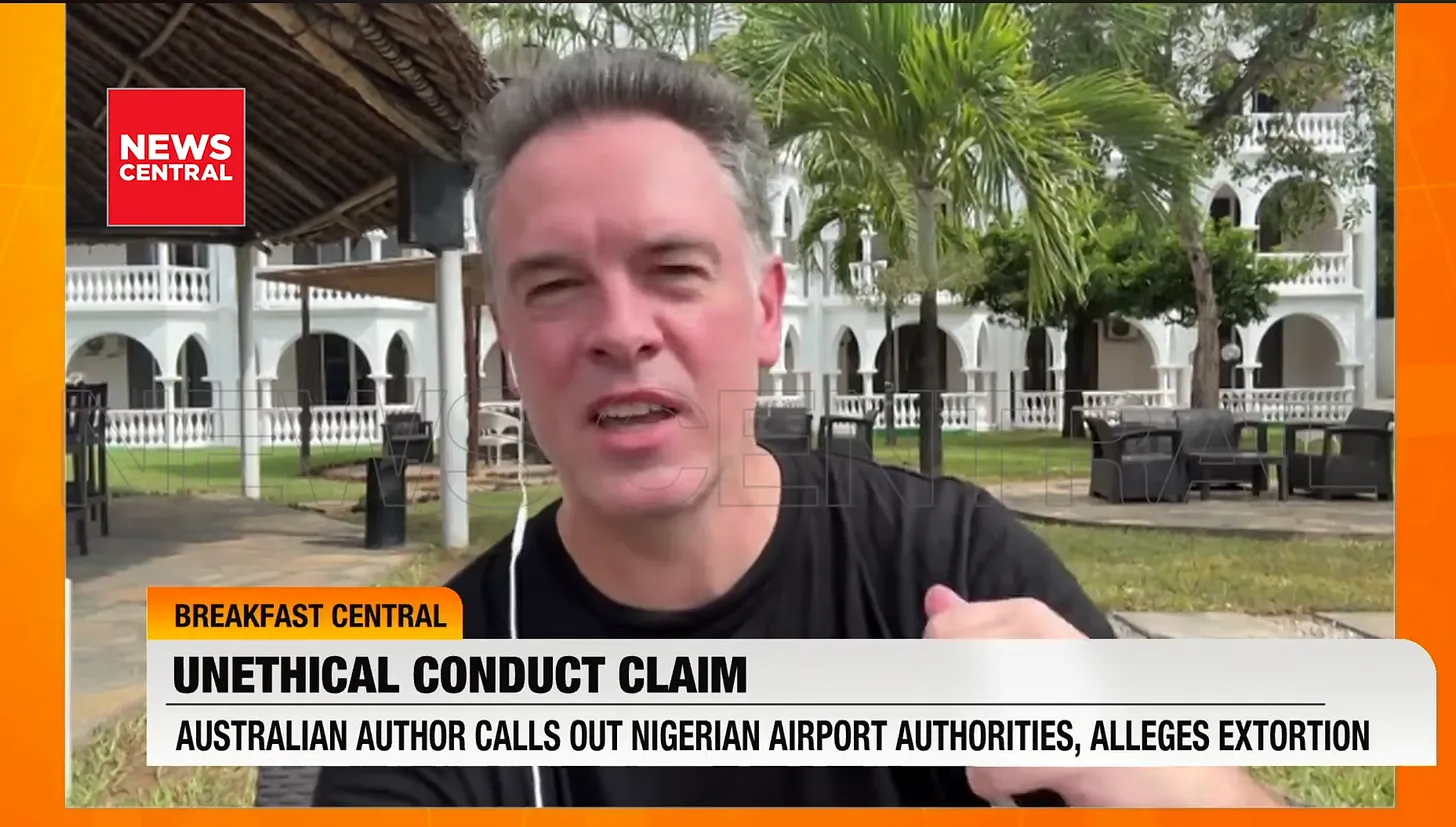
Then, as I left Lagos, I had to deal with more than thirteen people at the airport. Seven of them asked for money.
There’s no reason for Lagos airport to be like this except that someone has a vested interest in it being like this. Someone will intercept you as you walk to check in then ask you for money because they told you where to go. Later, you have to deal with all these separate people who do not need to be in the airport at all - one looks at your passport, another checks your exit visa, another asks if you’re carrying currency, then you walk past airport workers who ask for money, but the weirdest one was just before I boarded the airplane, a uniformed officer patted me down and repeated the pattern: “Where are you from? You have USD? Now you give me USD?”
I ignored him and he said, “Are you okay?”
But it led me to this thought: Nigeria seems set up for shakedowns.
My strategist brain never turns off. I’m constantly collecting patterns–hopefully with less paranoia than what I now feel after the past year of travel–then trying to name them. If you speak to me, my brain will listen for sentences like the one above.
This is an example of the strategist’s mind outside of the brief.
And you can see it on display on national Nigerian news here.
Here are other strategist behaviors that you can use outside of your dayjob:
1. Strategists turn patterns into ideas
Ideas combine at least two topics in novel and useful ways:
Topic A x Topic B.
My Nigeria experience lead to the idea that Nigeria is designed for shakedowns.
Topic A = Nigeria Topic B = Designed for shakedowns.
Ideas create new meaning. They get us to see the world around us differently. This sentence attempts this.
Another sentence I was told about Nigeria is this:
Nigeria is Africa on cocaine.
Topic A = Nigeria Topic B = Africa on cocaine.
A lot of strategists are good at finding patterns but strategists are strongest when they can turn the patterns into ideas.
Every slide of a research debrief, a trends report, or competitive review is stronger when an idea leads it. Dumping observations on people isn’t useful. Turn the pattern into a thing.
2. Strategists turn research into stories
I see a lot of decks. Most struggle to find a voice and point of view. Most dump information in decks as if the more information a deck contains the more important the deck is.
If you can focus on turning patterns into ideas then you can remove observations that do not support the idea because they become noise.
What’s more, you can turn your research into stories.
Since Colombia in June, 2025, I’ve written 40+ lyrics. I then play with them in Suno. I listen to people’s stories and I have my own adventures and then I turn them into songs.
For example:
-
What If Never is me replying to a student who had a brief romance in Mexico and asked, “What if I never feel that way again?”,
-
Man For What deals with stories and research I come across to do with a lot of heterosexual women being fed up with men, and
-
Hold Me (3k listens) is me processing my own feelings.
Strategists often ask, “What do strategists do after their strategy careers?”
Well, what if you continue to do what you do but you find a different shape for it - like music, painting, or fiction?
3. Strategists explore
A few years ago, a famous London agency got publicity for launching an initiative for its strategists to get away from their desks and explore their country. I was stunned because isn’t that what strategists do?
Now, not many people travel as much as I do but I travel to learn and to be changed. And my life is full of music. If I didn’t travel, I might have never fallen in love with these music genres and through these music genres I learn about people and culture:
- Brazil funk – Santa Rita do Sapucai (3 hours north of São Paulo), Brazil (2 a.m., standing next to MC Binn)
- Reggaeton – on a rooftop in Quito, Ecuador (through Bad Bunny’s “Callaita”)
- Dembow – Santo Domingo, Dominican Republic
- Merengue – Dominican Republic
- Bachata – Medellín, Colombia
- Salsa – Medellín, Colombia
- Amapiano – Johannesburg, South Africa
- Gengetone – Nairobi, Kenya
- Rancheros & corridos – Mexico City, Mexico
- Bongo – Mombasa, Kenya
- Afrobeats – Nigeria
Trying new hobbies, watching documentaries, reading books (fiction and non-fiction), and learning languages can help you explore if you can’t travel. You’ll emerge from all of these with a deeper understanding of the world and a new sense of self.
4. Strategists direct action
Strategy usually involves some combination of situation analysis, goal-setting, pattern-finding, plus declaring a strategy and connected tactics.
But how many strategists do this for themselves? We are our most difficult clients.
The two questions I focus on are:
A. What am I doing when I feel alive? (What are my verbs? e.g. write, teach, talk, travel)
B. Is there a community to which I can make a meaningful contribution?
My answers to these questions guide my life. And lead me into these sorts of situations:
- A massive Indian wedding in Bangkok (Congrats, Chirag and Sarah)
- Meeting some of Nairobi’s main radio shows, DJs, and MCs
5. Dealing with a fast and, sometimes, scrambled mind
As the marketing and agency worlds twist and turn through this era we’re in, many strategists will untether from what they thought were stable lives and livelihoods. For the past three years, I’ve heard a lot of stories about layoffs and the difficulties of freelance life. Sure, we all know people who are crushing it but many people are struggling.
I’ve hung out with a lot of you who do similar work. Yes, many of you are well balanced, but a lot of you deal with anxiety, ADHD, trauma, stress, and minds that don’t slow down.
I’ve felt scrambled many times in Kenya, especially on the one night that turned into two nights after drinking liquor, jaba juice (a naturally occurring stimulant), and konyagi (the only drink I’ve ever drunk and immediately vomited back out into the cup I was drinking from).
It’s difficult being a strategist without a brief. Without a company to work for, it’s like being a ronin. And, if you’re feeling like this now, your job is to write your own brief for the next phase of your life.
Follow me on Instagram @markpollard.

